Traffic robots are moving from a broad idea to a practical road-safety question: what can a machine detect, decide, and do near moving vehicles? The answer depends on the robot’s job, its sensors, and the road conditions it can handle.
- A camera can spot a vehicle, person, or blocked lane, but rain and glare can affect the view.
- A robot may warn drivers, guide traffic, inspect roads, or record events.
- Safety claims need results from public roads, not a staged test alone.
What a traffic robot could do
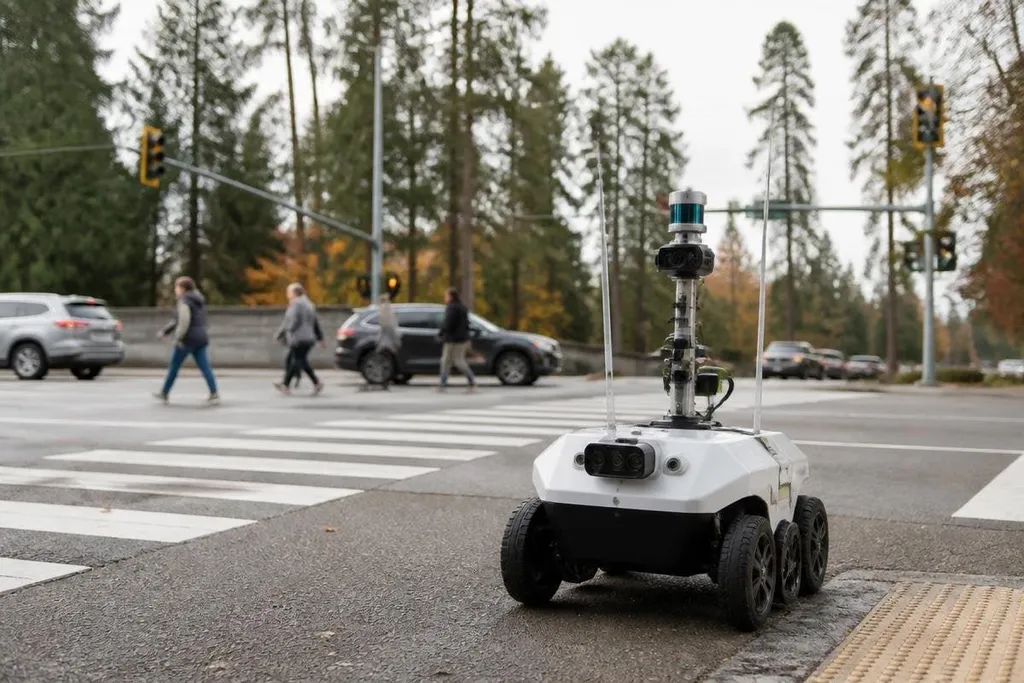
The phrase “traffic robot” covers several types of systems. A roadside machine might watch a crossing and warn people when a vehicle approaches. A mobile robot could inspect lane markings, barriers, or crash scenes while keeping staff farther from live traffic.
Another system could use cameras, radar, or LiDAR. LiDAR measures distance with pulses of light, giving the robot a map of nearby objects. A camera adds visual detail, while radar can help measure movement when visibility is poor.
Each sensor sees a different part of the road, so the robot needs software that checks those signals together. That work changes road safety in a practical way. A machine can keep watching one area for long periods, send an alert when it sees a set condition, and record the event for later review. It still needs a clear rule for what counts as danger. A loose object, a stopped car, and a person crossing may look similar from a distance.
Where the safety gain may come from
Road workers face risk when they place signs, inspect damage, or work near moving vehicles. A remote or autonomous system could take on part of that work while staff remain outside the traffic lane. The benefit would come from the task it removes from a person, not from the word “autonomous” on a product sheet.
A warning robot could also give drivers more time to react. That claim needs a measured result: how far away did the warning begin, how many drivers responded, and what happened when the road was wet, dark, crowded, or partly blocked? Without those details, a bright warning light may look useful while doing little for crash risk.
A road agency comparing warning robots can use Robot24 to check the test site, warning distance, weather, driver response, and crash result behind each claim. Those details belong beside the radio link and fallback plan, since a warning that works only in clear conditions isn't ready for public roads.
The control link matters too. A remote operator may need to take over when the robot meets a case its software does not recognise. That link must keep working near buildings, tunnels, heavy traffic, and other sources of radio interference. If the connection drops, the robot needs a safe stop or a clear fallback action.
What remains unproven
No evidence pack was supplied for a named traffic robot, so this article cannot verify a model, price, deployment count, safety result, or test date. That limit matters because road safety depends on details that vary from one system to another.
A road trial should show the robot in the place where it will work. It should include day and night conditions, rain, glare, parked vehicles, roadworks, and people who do not behave like test subjects. The report should also state how often the system missed an event and how often it raised a false alarm.
Human response needs its own check. Drivers may ignore repeated warnings, while road workers may rely on an alert that arrives late. A useful test records when detection occurs, when the message arrives, and how people act after receiving it.
A practical check before buying or approving one
Use this checklist when a supplier presents a road-safety system:
- Name the task: write down the exact job, such as lane inspection or crossing alerts.
- Set the conditions: include weather, light, traffic speed, road layout, and radio coverage.
- Ask for misses: request the false-alarm rate and the cases the robot failed to detect.
- Check the fallback: confirm what happens after a sensor fault, lost connection, or low battery.
- Measure people: record driver or worker response time, not only the robot’s detection time.
- Set a review date: compare the trial result with the safety target before wider use.
The useful next step is a named trial with public results. Until a system shows how often it detects hazards, how people respond, and what happens during failure, traffic robots remain a promising safety tool rather than a proven one.